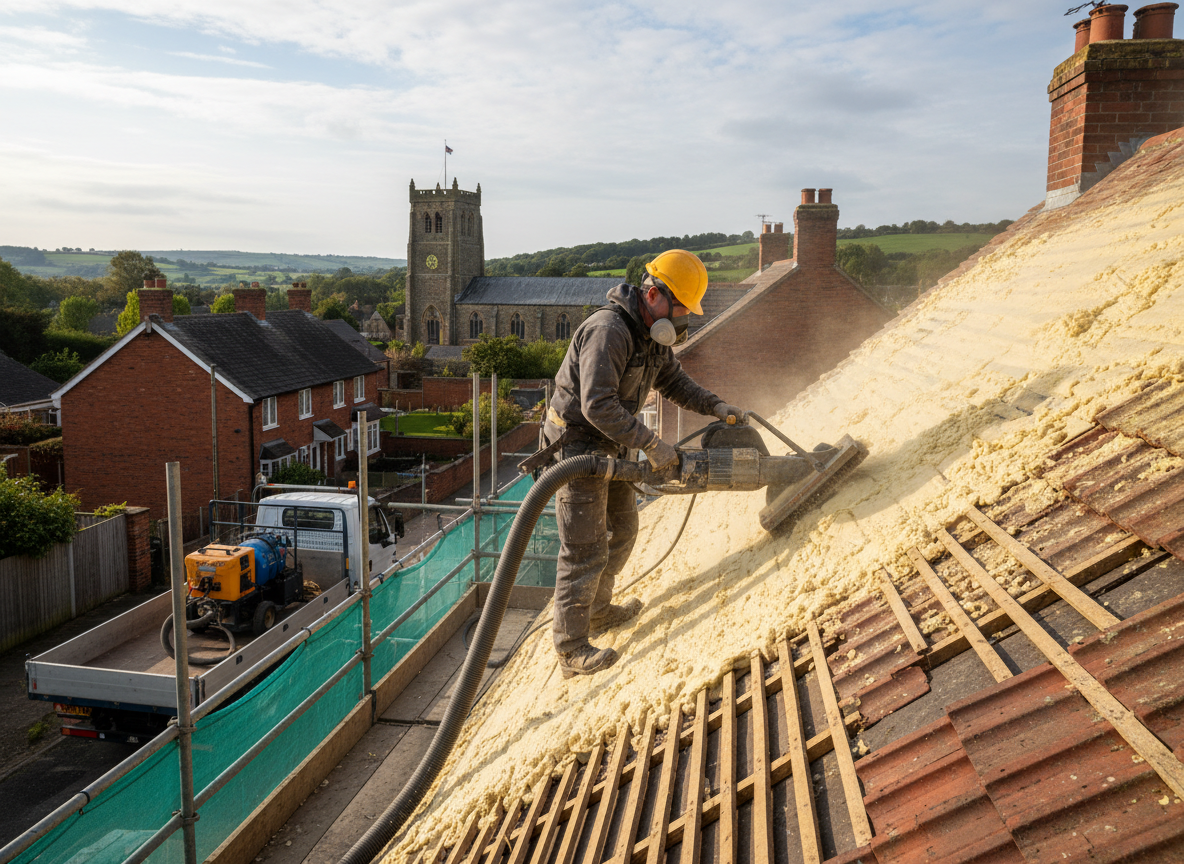
York's housing stock includes many Victorian terraces and Georgian stone buildings where spray foam was once applied directly to roof undersides. In the region's frequent rain and mild winters this creates trapped moisture against slate or tile, leading to rot in timber battens and reduced airflow through the roof void. Removal requires cutting the foam in controlled sections to avoid dislodging loose slates common on properties built before 1900.
Edge cases arise in Heslington and similar conservation areas where listed building consent may be needed before disturbing original roof structures. Technicians must work around existing insulation layers and electrical wiring that often runs through the same voids. Failure to restore ventilation after removal can leave properties vulnerable to condensation on cold roof decks during autumn and spring.
Code considerations include ensuring the roof void meets current Building Regulations for ventilation once foam is gone. In North Yorkshire's clay-heavy soils and flat terrain around York, poor drainage around older properties can worsen any remaining damp once the foam barrier is lifted, requiring checks on eaves and ridge vents during every job.
Technician insight
In York, the thing that catches most people out with roof spray foam removal is how quickly moisture builds behind the foam on slate roofs in Victorian terraces around Heslington once our damp winters set in, especially when eaves have been completely sealed.
Foam Removal in a York Terrace Loft
Owner of a pre-1900 terrace reported musty smells in the upper rooms. Inspection showed spray foam covering all rafters and blocking every vent. Foam was sectioned and removed without disturbing the original slates. Eaves and ridge were reopened to restore airflow, eliminating the damp issue.
How it works
- 1
Site Assessment
Inspect the roof void, identify foam type and thickness, and check for existing damage to timbers or slates.
- 2
Safe Removal
Cut and extract foam in sections while protecting wiring and original roof materials from dislodgement.
- 3
Ventilation Restoration
Clear blocked eaves and ridge vents and confirm airflow meets requirements for the property age.
- 4
Final Check
Verify no foam residue remains and document the condition of the roof structure for the homeowner.
Pricing
Cost depends on roof size, foam depth and access difficulty in older York properties; upfront quote provided after inspection.